

Terfezia dunensis Ant. Rodr., Cabero, Luque & Morte
Persoonia 43: 411 (2019)
Etymology:
In accordance with the habitat (coastal dunes).
Macroscopic characters:
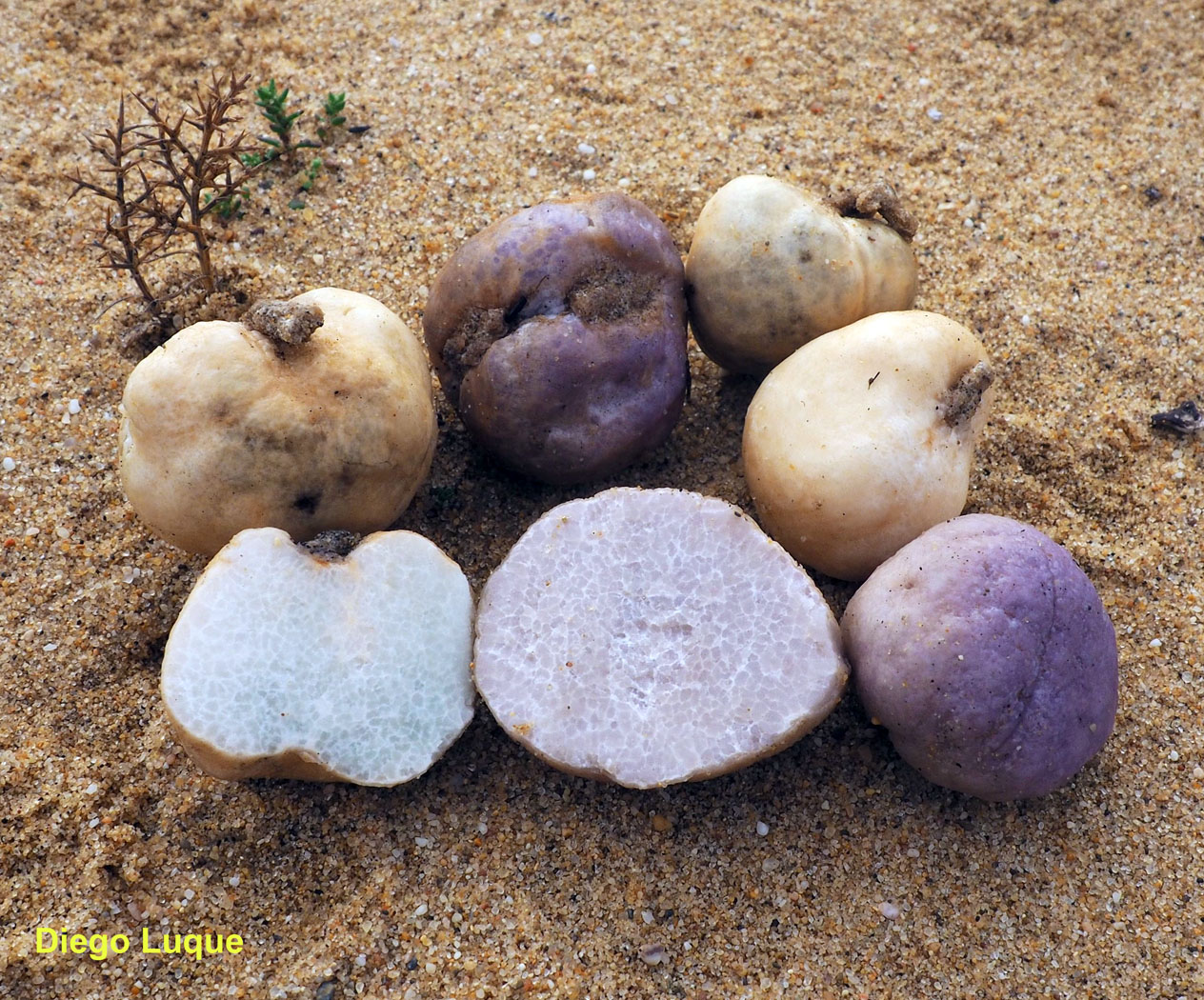
Ascomata: hypogeous to partially emergent at maturity, 2–5 cm, globose to subglobose, sometimes gibbous or lobed, often with a tapered, sterile short base with a thick mycelial cord; cream-coloured at first, becoming lilac to pale lavender, then ochre-brown with black spots; smooth, rough to tuberculate at full maturity.
Peridium: 150–500 μm thick, whitish in cross-section, pseudoparenchymatous, composed of subglobose cells, 40–90 μm diam., thin-walled, hyaline, yellowish and angular to oblong in the outermost layers.
Gleba: solid, fleshy, succulent; whitish with small pale grey pockets at first, soon becoming lilac, then brown, maturing to dark grey to black pockets of fertile tissue separated by whitish sterile veins.
Odour: spermatic. Taste: acidic, unpleasant.
Habitat:
Terfezia dunensis grows in coastal sand dunes, in acidic soils, associated with Halimium halimifolium and Cistus salvifolius, from January to March.
Notes:
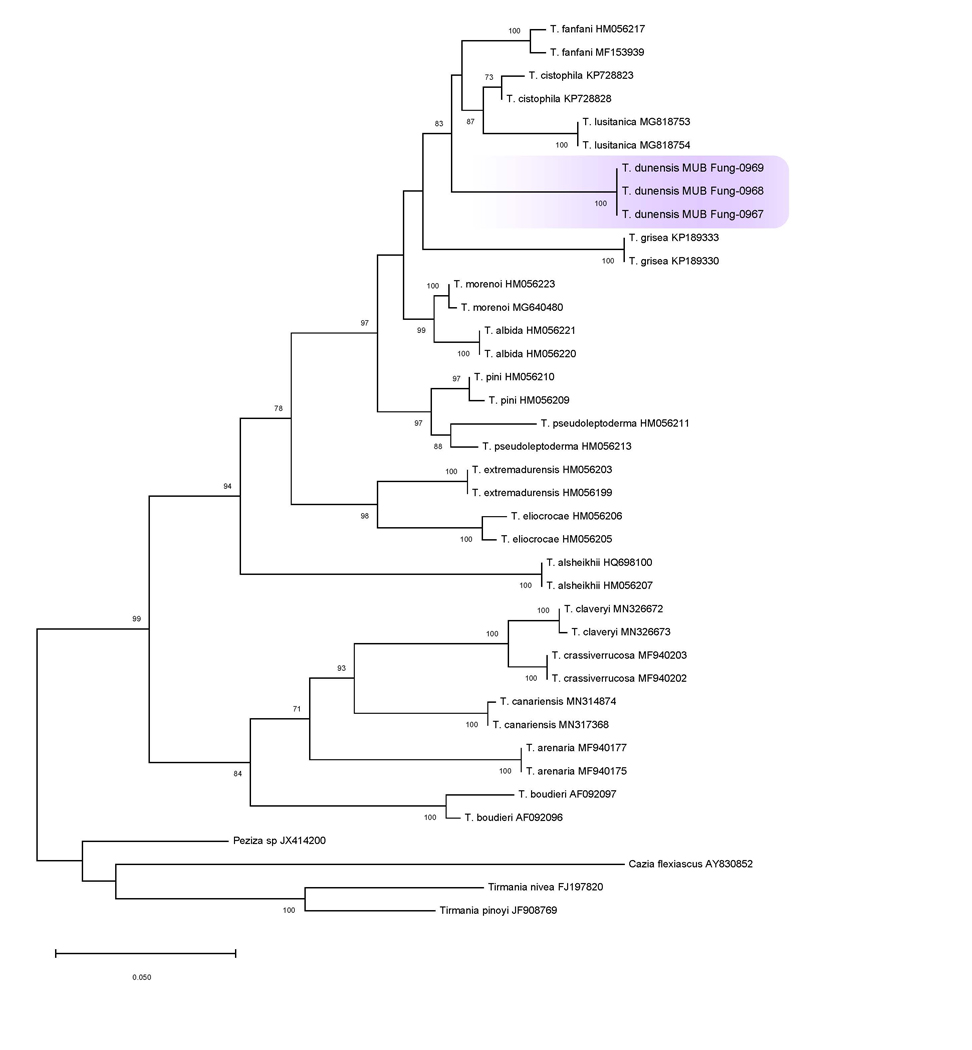
Terfezia dunensis is a spiny-spored Terfezia species characterised by its acidic coastal dune habitat, association with Halimium halimifolium and Cistus salvifolius, lilac colours of peridium and gleba, and spermatic odour. It differs from all other spiny-spored species by its habitat and lilac colour, which is unique in the genus Terfezia. Terfezia cistophila and T. albida have a spermatic odour but differ in habitat, colour and spore characters (Bordallo et al. 2013, 2015). Moreover, the new taxon is distinguished from all Terfezia spp. by its ITS nrDNA sequence.
Microscopic characters:
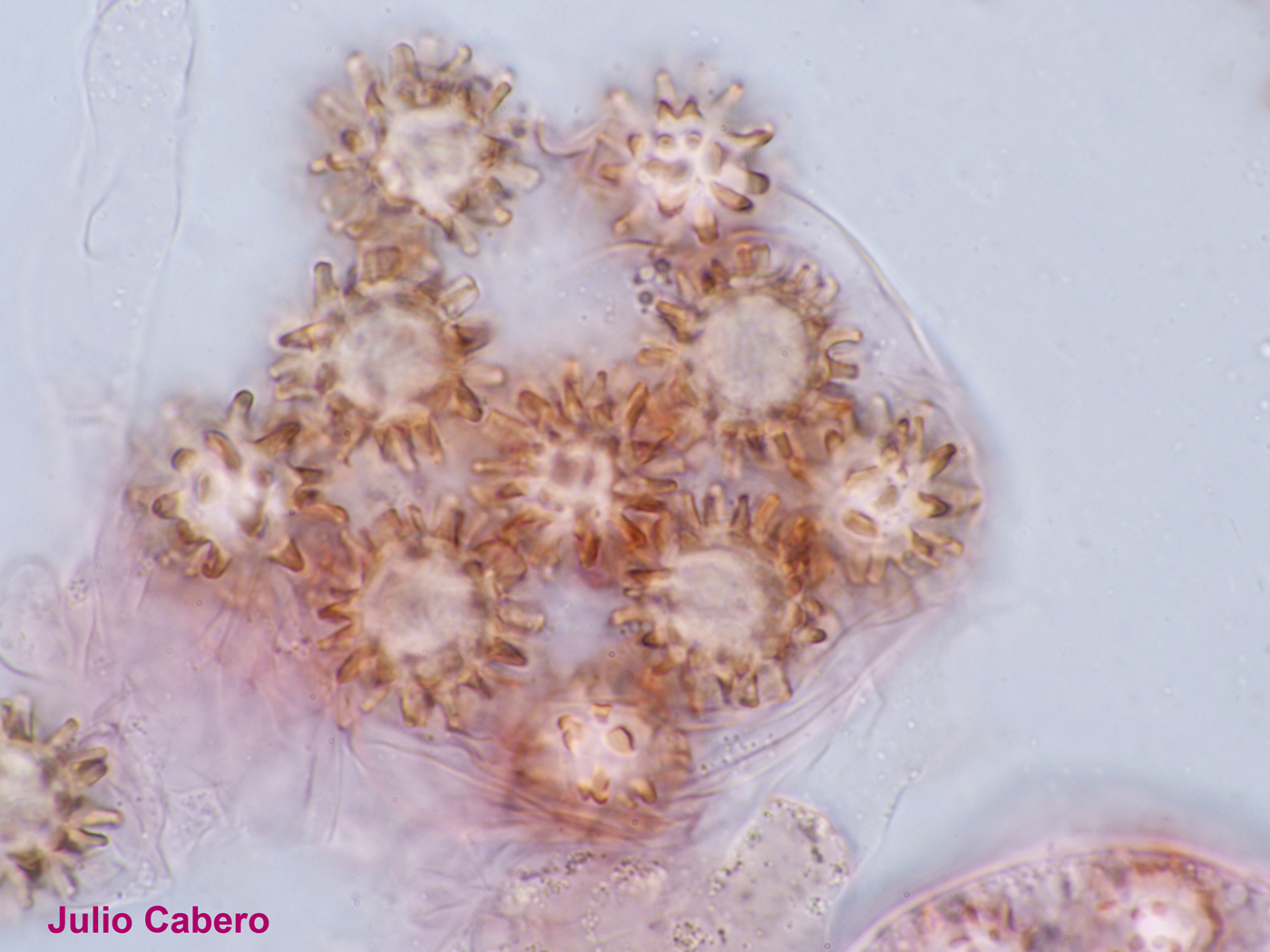
Asci: inamyloid, ellipsoid to ovoid, citriform, sessile or short-stipitate, 60–90 × 50–60 μm, with walls 1–2 μm thick, with 6–8 irregularly arranged spores, randomly distributed in fertile pockets.
Ascospores: Globose, (16–)16.5–19(–19.5) μm diam. (median = 18 μm), including ornamentation, (13.5–)14–16(–16.5) μm (median = 15 μm) without ornamentation, hyaline, smooth and uniguttulate at first, yellow-ochre at maturity and ornamented with separate, straight, pointed, conical spines, 1–2(–2.5) μm long and 1 μm wide at the base.
Peridium: 300–500 μm thick, whitish in cross-section, pseudoparenchymatous, composed of thin-walled, hyaline, subglobose cells, 20–50 μm diam., becoming yellowish and angular to oblong in the outermost layers.
Phylogenetic analysis:
Maximum likelihood (ML) phylogenetic tree inferred from ITS sequences, using RAXML-HPC v. 8 (Stamatakis 2014) on XSEDE in the CIPRES science gateway (Miller et al. 2010). GTR + G selected as model of evolution for analysis. Bootstrap support values (≥ 70%) are indicated at the nodes. Cazia AY830852, Peziza JX414200, Tirmania JF908769 and Tirmania FJ197820 were used as outgroups. The scale bar indicates the expected changes per site.
 |
Antonio Rodríguez trufamania@gmail.com antonio@trufamania.com ORCID iD: 0000-0002-0708-7773 |